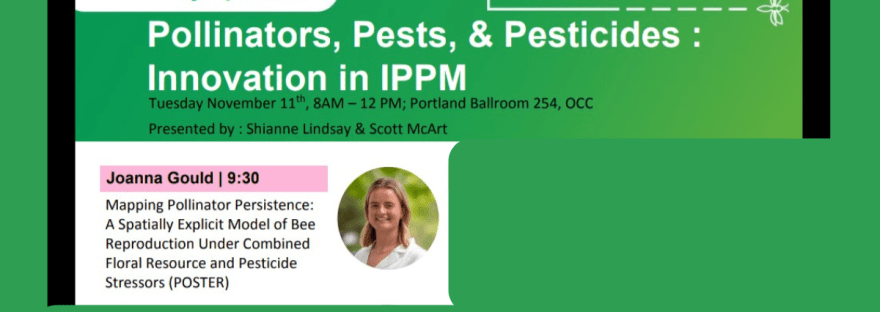
Woot! Woot! or Buzz! Buzz! A hearty congratulations to Joanna Gould C26 who recently returned from attending the Entomology 2025 conference in Portland, OR. Joanna presented the research she has worked on under the supervision of Dr. Eric Lonsdorf – Mapping Pollinator Persistence: A spatially explicit model of bee reproduction under combined floral resource and pesticide stressors.
Joanna’s experience was supported by the ENVS department through the Lester Conference Scholarship.
As she reflected on her experience, Joanna had these key takeaways –
Presenting my poster at Entomology 2025 was my first experience sharing research in a professional setting, and it completely changed how I think about scientific communication. Talking with researchers from different backgrounds pushed me to explain my model clearly and concisely, while still engaging with complex ideas about spatial ecology and pollinator persistence. I found the most valuable moments were the conversations that started with simple curiosity, questions that led to unexpected discussions about data structures, trait variability, and field applications. Seeing how others connected my simulation work to real-world management and policy helped me recognize the broader impact of modeling. I also appreciated learning presentation strategies from seasoned scientists, how they used visuals, storytelling, and humor to make technical findings accessible. Overall, the experience made science feel more like a dialogue than a presentation, and it strengthened my confidence in communicating my work to both expert and interdisciplinary audiences.
The conference gave me new ways to think about linking models to management decisions. Hearing from researchers who integrate pesticide exposure data, floral resource mapping, and behavioral traits helped me identify next steps for refining my own queen bee population model. I plan to incorporate temporal variability and better quantify thresholds of persistence, concepts that come up repeatedly in talks and discussions. Beyond technical insights, the conference showed me the importance of collaboration across lab, field, and policy domains. I left inspired to build connections between my modeling work and applied conservation efforts, especially through partnerships with organizations that use data-driven tools for pollinator protection. Academically, it reaffirmed my interest in spatial ecology and strengthened my motivation to pursue graduate research in quantitative conservation science.
 Department of Environmental Sciences