By Easton Lane 25C
From February 4-6, ENVS students Laurel Garcia (25C) and Anisha Johnson (25C) attended the SOWTH 2025 Conference: Connecting the Region for Bolder Collective Impact. Hosted by Georgia Organics at the Georgia World Congress Center, this conference saw the gathering of hundreds of regional farmers to discuss important issues and strategies for community building.
Garcia and Johnson were able to attend thanks to Turner and Lester grants, respectively, and thanks to ENVS’ Dr. Emily Burchfield, who directed them to this opportunity. Dr. Burchfield’s Sustainable Food Systems (ENVS 323) was an overlapping point of interest for both Garcia and Johnson, who followed each of their specific interests to different panels at SOWTH.
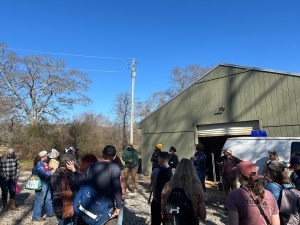
“During the first day,” Johnson says, “I attended a farm tour to the Love is Love Farm in Mansfield GA, as well as a food safety workshop. Both were very hands-on experiences and taught me a lot about what it is like to be a farmer in the Southeast.”

As a double major in Environmental Sciences and Economics, Johnson approached the SOWTH conference from an interdisciplinary perspective, seeking to understand agricultural realities and their interactions with economic and environmental pressures.
“Climate-smart agriculture, while it is beneficial for the environment, can be extremely draining on farmers’ pockets, so I wanted to hear from them directly to understand this disparity,” Johnson says.
Garcia approached the conference from a slightly different perspective, pairing her environmental education with her background in cultural agricultural practices and her passion for the support of public food systems. Her experience hearing from several different panels at SOWTH was both informative and perspective-shifting.
“I went to SOWTH with an interest in small-scale farming and sustainability,” Garcia says, “but I came out with a greater interest in community building. Without support from their community, many of the farmers would not have been as successful. The farmers’ hard work has helped fund research in our schools. We all help each other become better.”
Among the panels Garcia attended, she noted Dr. Gemma Wenner’s “Cultivating Community and Sustainability with Agritourism and Agrihoods” as a personally impactful experience.
“Right before this conference,” Garcia says, “my oldest brother mentioned wanting to grow a field of sunflowers in our hometown to promote our community and his love for his wife. I attended this session to learn how Dr. Wenner did it and my biggest take away was to let the community help and get them interested by educating, incorporating local universities, and creating activities for the children of the community.”
Johnson left SOWTH with a similar takeaway, echoing the ground-up approach that this year’s conference embraced.
“SOWTH taught me about grassroots movements and taking power into your own hands. Sustainable food systems are important and everyone has a role to play in improving their functionality and sustainability,” Johnson says.
As a region-specific microcosm of larger trends in agriculture, SOWTH provides student attendees a valuable lens into potential solutions and issues currently impacting the industry. Both Johnson and Garcia consider their time at the conference to have been well-spent, and they would be likely to recommend the experience for students pursuing an environmental science major or minor.
“I would highly recommend attending the SOWTH conference,” Johnson says, “especially to students interested in sustainable food systems and learning more about America’s agricultural system. Although it is a complex topic, I feel it is important for everyone in the ENVS field to understand it to some extent.”
In a time when uncertainty about the federal government’s commitment to healthy environments and sustainable agriculture is widespread, organizations like SOWTH are important reminders that change does not always come from the top. In the pursuit of better American food systems, it’s vital for students like Garcia and Johnson to learn about grassroots movements and community building through conferences like SOWTH 2025: Connecting the Region for Bolder Collective Impact.
 Department of Environmental Sciences