We asked, and she answered, how an interest in humanities and social sciences blossomed into becoming a student research scientist.
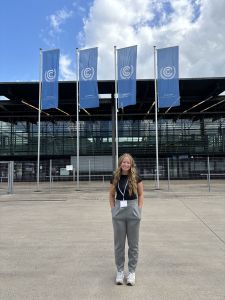
It’s hard to know where to start when profiling a student like Kylie Hanson. A student-athlete on the Emory track team, a double major, a researcher in the Saikawa Lab, and a student with an abiding interest in the intersection of climate science and policy, Kylie really does it all! Earlier this summer, Kylie attended the SB60 conference in Bonn, Germany as part of Emory Climate Talks, this was right after winning first prize in the undergraduate poster conference at the Air & Waste Management Association Annual Meeting. Kylie has charted her own unique path at Emory and so we asked her to share her journey and what she hopes to do as she begins her final year at Emory.
What did you think you wanted to major in when you started at Emory?
When I first came to Emory, I thought I would major in political science on the pre-law track. I disliked chemistry and biology in high school, so I didn’t want to touch anything STEM-related in college. I was drawn to the humanities and took classes in history, sociology, political science, etc.
How did you decide on Political Science/ENVS?
During the spring of my freshman year, I had some extra room in my schedule and decided to take “The Foundations of Soil Science.” I had been generally interested in sustainability, but never interested in learning earth science, especially the small chem/bio elements which I feared would come with it. However, to my surprise, I really enjoyed learning about soil. I learned about small elements that make up soil, like how its microorganisms, physical structure, etc., played a larger role in determining soil health, which played an even larger role in determining ecosystem health and stability. More importantly though, I realized that science that explains how our earth/environment operates at a larger scale was actually really interesting, and I wanted to dive in. So, I declared my ENVS major the following year!
I found that my ENVS major paired really well with my political science major. The classes I took in atmospheric science, ecology, and even soil science supplemented my education in international relations, political systems, and public policy. Specifically, these two majors have led me to understand the science behind climate and environmental policy. I am grateful to have this multi-disciplinary background.
How did you start your research in the Saikawa lab?
I wanted to get involved in a lab in order to gain some research experience. I really liked the Saikawa Lab when I was looking into which lab I could apply to join; its focus on climate change and air/soil quality were areas of study I was very passionate about and interested in. Therefore, I asked to join and started in the fall of my junior year. When I joined, I was assigned the anaerobic digestion project, which ended up being the majority of my work in the lab, and it still is today!
What is your research focus there and a little history about research and work in the lab and perhaps what has been most rewarding about that experience?
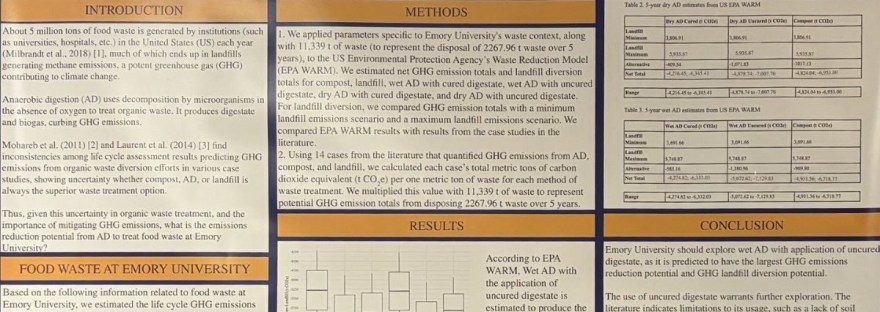
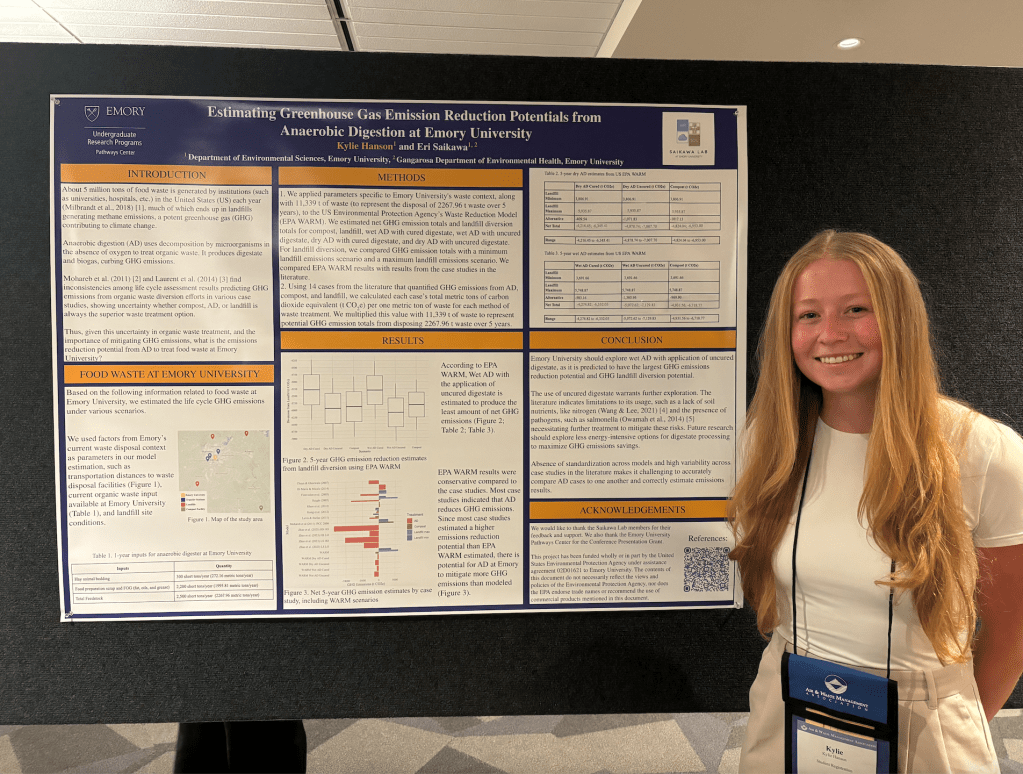
I am researching the treatment of food waste by anaerobic digestion, and more specifically, estimating greenhouse gas emissions from different methods of waste treatment (like anaerobic digestion, compost, and landfill). Emory is interested in building an on-site anaerobic digestor to treat food waste, however before doing so, it is important to get an accurate estimate of its environmental impact. Therefore, we have been researching lifecycle models that estimate greenhouse gas emissions from waste treatment. We found a model that can provide us with a big-picture estimate of greenhouse gas emissions from different anaerobic digestion scenarios that Emory could pursue. Using this model with data specific to Emory, we found that anaerobic digestion to treat food waste would produce net negative emissions.
I think the most rewarding part of this research has been pushing myself into an area I was unfamiliar and uncomfortable with and eventually succeeding. This was my first time in a research position; I didn’t know anything about modeling emissions, let alone what anaerobic digestion even was before I started. It took a lot of time reading, researching, and learning to become comfortable with these subjects. Now, I can confidently present my findings to others, and that is something I am really proud of. Besides this, I have learned so much about air and soil quality from my fellow lab members. Everyone is constantly sharing about the cool work they are doing in the lab, and it excites and motivates me. My experience in the Saikawa lab has truly been rewarding in so many ways.
Can you give a brief explanation of your recent conference presentation and about your award?
I presented my research at the Air & Waste Management Association’s Annual Conference and Exhibition in Calgary, AB. I participated in the student poster competition, where I won first place in the undergraduate poster category.
What are you hoping to accomplish in your final year at Emory?
During my final year at Emory, I hope to expand my research on anaerobic digestion and turn it into my honors thesis. We hope to publish this research in a journal as well. I hope this research makes an impact on mitigating emissions from food waste on our campus. After Emory, I want to pursue law school to eventually work in environmental law.
What do you enjoy doing at Emory when you are not studying/researching?
When I am not working in the lab or doing my homework, I am most likely spending my time on the track as an athlete on the varsity track team, registering people to vote in Asbury Circle with the Young Democrats of Emory, or spending quality time with my friends (usually watching the Bachelor).
 Department of Environmental Sciences