
Each year, it is our honor to announce the James G. Lester Scholarship in the Department of Environmental Sciences (ENVS), a scholarship that recognizes an exceptional rising senior in ENVS. This year, we are pleased to announce that Greta Franke (25C), who is pursuing a BS in ENVS on the Ecology & Conservation track, has been named the ENVS Lester Scholarship recipient. Named for James G. Lester, who founded Emory’s geology department, Lester joined Emory’s faculty in 1919, and continued to make contributions throughout his tenure. His contributions can still be seen at Emory today through the ENVS-affiliated scholarship awarded to a rising senior each year.

As a double-major in ENVS and Music, Greta has expertly combined her twin passions here at Emory. Along with her demanding coursework, she has found time to immerse herself in research and serve as a leader in student organizations that run parallel to her academic interests. Greta serves as a peer mentor in the Department of Environmental Sciences. In this role, she is a resource for current and prospective students in ENVS and was instrumental in organizing our super successful “Get the Scoop” event last year that highlighted student research opportunities with ENVS faculty.
As a leader for Emory’s Summer Outdoor Adventure Retreat (SOAR) pre-orientation program for the past two years, Greta helped create community with incoming students through outdoor activities — something she is passionate about. She is also a senior trip leader for Outdoor Emory, an organization that connects students through activities such as ziplining, sea kayaking, hiking and camping throughout the school year.
Greta serves as a field technician for Emory Ecological Society, participating in student-run research projects around campus and the greater Atlanta community. For Greta, “This is a super-fun way to get outdoors and meet other students with similar interests. The project I am currently leading focuses on American chestnuts, an imperiled species. The work consists of identifying chestnuts around Emory’s campus and recording their location for future mapping.”
Greta is engaged in student organizations that fill her musical cup as well. She is proud to sing in the Emory Concert Choir alongside the exceptionally talented student musicians here at Emory. Additionally, she is the music director of Dooley Noted, Emory’s service-oriented a cappella group. As one of the first groups she joined during her freshmen year, Dooley Noted has become Greta’s home away from home. Somehow Greta also finds the time to serve as the vice president of Mu Phi Epsilon, Emory’s professional music fraternity. Mu Phi Epsilon promotes the advancement of music in the Emory community with an emphasis on both scholarship and service.
Greta’s research journey began with the Scholarly Inquiry and Research Experience (SIRE) program during her second year at Emory. This year-long commitment is geared toward first-time researchers and helps students build essential research skills while learning about important topics such as ethics and public speaking. For her SIRE project, she worked with ENVS faculty member, Dr. Tony Martin, on a study of Skidaway Island — a barrier island located on the Georgia coast. Her project involved mapping the history of urban development on the island. At the end of the experience, she presented her findings at the Emory Undergraduate Research Symposium.
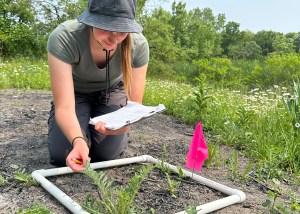
According to Greta, “My SIRE experience really kickstarted my interest in research, and it motivated me to seek out science-oriented summer opportunities. In summer 2023, I participated in an NSF-funded Research Experience for Undergraduates (REU) at the Morton Arboretum in Illinois. My project, based in a soil ecology lab, involved investigating how brush-pile burning affects soil properties and plant communities. I was able to work in both the lab and field environments, which I really enjoyed.”
During her junior year, Greta transferred her soil science and biogeochemistry skills to the Sihi Lab, where she assisted graduate students with their research projects. Being able to see their theses come to fruition was very inspiring. Greta developed critical laboratory skills and connections to her peers and Dr. Sihi throughout the year. This summer, she has returned to the Morton Arboretum as a 2024 Research Experience Extension Fellow (REEF). She is expanding on the brush-pile studies conducted last year and collecting more data for analysis. She is looking forward to seeing how the new results match up with last year’s findings.
If you are wondering when Greta sleeps, we are too! But we are thrilled that Greta calls ENVS home, and we are excited to see how her involvement and research blossom during her senior year. We invite you to celebrate Greta’s achievements with us and congratulate her on her Lester Scholarship.
In Greta’s own words:
Favorite Class so far in ENVS:
Ecosystem Ecology Lab (ENVS 240L) has definitely been a highlight of my Emory experience. Having two continuous hours of time devoted to field and lab work allowed everyone to dive deeply into various projects. A particular favorite was traveling to Arabia Mountain and analyzing the plant communities found in the pools of water on top of the monadnock. This course really allowed us to take advantage of the beautiful natural spaces in close proximity to campus.
Favorite campus activity/tradition:
My favorite campus activity would have to be the Festival of Nine Lessons and Carols, which is a set of winter concerts put on by the Emory Concert Choir and the University Chorus. The annual concerts require a lot of planning and rehearsal time, so seeing our work culminate in a seasonal celebration is really wonderful. It’s a fun breath of fresh air before winter finals begin!
 Department of Environmental Sciences